Drawing Methods
I do most of my drawings on Fabriano hot-pressed watercolor paper, a 100% cotton paper with a soft and smooth surface. Cotton papers are always to be preferred over standard wood-pulp papers, due to the superior longevity of cotton and its more agreeable surface qualities.
I stretch the paper as if I were preparing it for normal use with watercolor: I soak the paper in water for at least 30 minutes, allowing it to expand, and then I staple it to a drawing board and allow the paper to dry thoroughly. As it dries, it contracts, pulling tight and flat. Stretching the paper in this manner precludes the warping and bulging that can occur due to changes in atmospheric humidity, and ensures that the paper stays flat and secure throughout the duration of my work.
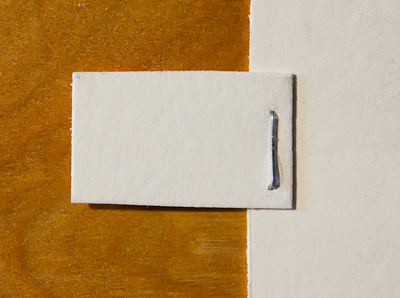
I find it useful to place a small tab of paper underneath each staple as I secure the soaked paper to the drawing board. This makes it much easier to remove the staples when the work is finished; otherwise, they can be miserably difficult to pull up, resulting in awkward struggles that can endanger the fragile work - one careless slip with a tool can be the end of a painting that took weeks to accomplish. Instead, simply placing a tab of paper between the staple and the work allows the staples to be removed safely and easily simply by pulling up on the tab. Even if an especially stubborn staple refuses to come up completely, the tab method usually loosens it enough to allow it to be extracted with needle-nose pliers with little effort. Here's what my paper tabs typically look like:
These tabs need to be made of durable paper, of course, so I use the same 300-lb paper that I work on - I always have discarded scraps of that stuff readily available, so I just cut them up into these tabs about an inch wide and maybe two or three inches long. I keep dozens of them in a bag, ready for use at any moment, and I apply just enough staples to ensure that the soaked paper will stretch tight and flat as it dries. Below is a photo of a finished work, "Passing Storm," with the stapled tabs holding it in place on my drawing board:
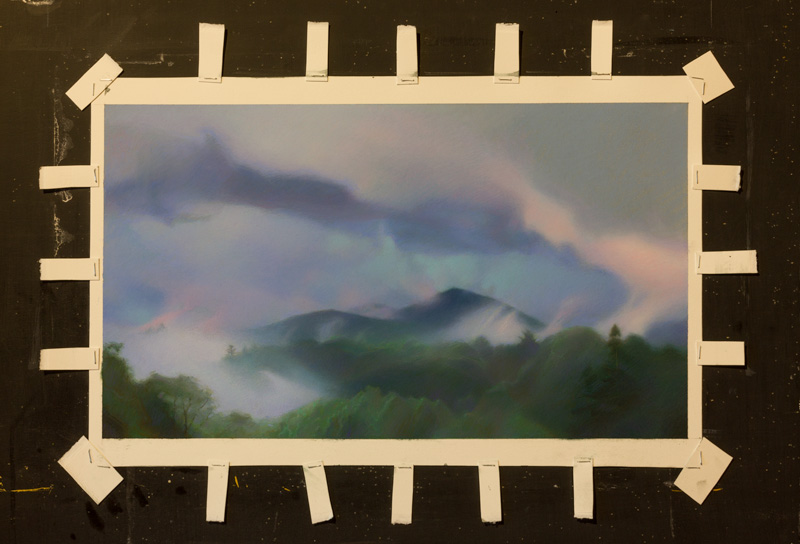
The paper remains stapled to the board until the drawing is completely finished. Whenever possible, I cut the paper to a size that includes about two inches of empty space around the perimeter of the work, to allow room for the staples. I measure and mark the inner dimensions of the image, and apply tape along the edge to more clearly define the boundaries of the image. Once the work is complete, I remove the tape to reveal a clean border all around.
The toning of the paper is very important. I don't typically work on white. I use pastel, charcoal or watercolor - or somc combination of them - to tone the page. I prefer to create a middle-range tone, rather than one that's either too light or too dark. By working on such a tone, I'm beginning in the middle of the value range, and can then build the drawing in two directions at once: rendering shadows by adding dark marks, while also creating bright areas of light through the use of white charcoal, conte crayon, pastel or gouache. The bright marks are immediately visible because they're isolated against the darker tone that covers the entire paper.
My drawing tools include graphite, vine charcoal, charcoal pencils, conte crayons (in various colors, including sanguine, sepia, black and white). My preferred variety of charcoal pencils are those in which the charcoal is surrounded by a wrapping of paper rather than wood - I find that wood is too difficult to sharpen with standard blade sharpeners, which go dull quite quickly and shatter the charcoal more often than not. Instead, the paper pencils are more practical because they can simply be unwrapped to reveal the charcoal interior, and then the charcoal can be sharpened by rubbing it against sandpaper. I get much more successful results from this method, and a lot less aggravation.
Although I do some drawings as independent, stand-alone works, many of them serve merely as relatively small scale drawings in preparation for subsequent paintings. The drawing helps me to get well acquainted with the subject as I finalize the composition and confidently determine the placement of all elements within the picture.
I then transfer the drawing to the larger canvas by means of a grid system that allows me to reproduce the drawing with some accuracy at a larger scale. This procedure is made easier by the use of a simple device: a sheet of clear plexiglass, on which I've drawn a grid of one-inch squares. I lay the plexiglass grid over my finished drawing - in this way, I can avoid having to render the grid lines directly onto the drawing itself, so the integrity of the drawing is preserved. I then establish a larger grid on the canvas, which may be two or three times bigger than the scale drawing, and then I simply copy the drawing one square at a time.